
Dry Water
On finishing the Narnia books again

The seminarians I teach at University of Mary for the Diocese of Phoenix asked me this semester, “Father Matt, how many books do you read in a week?” I said that it depends on the type of book. That particular week that they were asking me, though, I had read three of the Narnia books.
C.S. Lewis wrote seven Narnia books that more or less follow the trajectory of a family and their adventures in Narnia and the surrounding lands. The chronological order of the books, the order in which the events happen, is not the same as the order in the which the books were published. My friend Zach who lent me the books told me I HAD to read them in the order of publication. I chose to read them in chronological order. I figured, this was the third time going through these books, so I could do what I wanted!
The orchestrator of the adventures of the Pevensey family in Narnia is Aslan, the Lion, the Son of the great Emperor-Beyond-the-Sea. When, in The Lion, the Witch, and the Wardrobe, the children first hear about Aslan from Mr. and Mrs. Beaver and that he is a lion, Susan says, “I’d thought he was a man. Is he-quite safe? I shall feel rather nervous about meeting a lion”...“Safe?” said Mr Beaver ...“Who said anything about safe? ‘Course he isn’t safe. But he’s good. He’s the King, I tell you.”
The fact that Aslan is not a safe lion, not a tame lion, but at the same time is a good lion proves itself again and again in the seven books. I want to reflect for a moment, though, on the separation of “not safe” and “good” in the seventh book, The Last Battle, as the key to the spiritual message of the Narnia books. It is no secret that these books follow the Christian story and that the seventh book in particular picks up themes from the biblical Book of Revelation.
When the Ape dresses up Puzzle the donkey as a lion and presents this lion as Aslan to the Narnians, we can see the echo of the false prophet who deceives the world in the Book of Revelation, Chapter 13. One other thing about this beast is that he utters blasphemies (Rev 13:5).
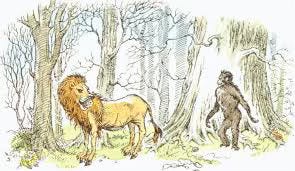
The particular blasphemy of The Last Battle is not first uttered by Puzzle or the Ape but by Jewel the unicorn and King Tirian: “Is it not said in all the old stories that He is not a tame lion?” “Well said, well said, Jewel,” cried the King. “Those are the very words: not a tame lion. It comes in many tales.”
What are Jewel and King Tirian forgetting? “But he is good.” He is not just “not tame” or “not safe”; Aslan is also good. We forget this to our peril. And here is the whole drama of Lewis’s seventh Narnia book.
When King Tirian come across a talking horse being treated like a beast of burden by a Calormene (the enemy nation), the Calormene says that it is by Aslan’s orders. Jewel asks, “How could Aslan be commanding such dreadful things?” King Tirian responds, “He is not a tame lion…How should we know what he would do?” That Aslan could not be relied upon, that Aslan would change his behavior from one moment to the next, that Aslan was not the steady ground on which one could build one’s life—what a disorienting experience this is for the King and the creatures of Narnia!
Can we rely on Aslan? Is there always lurking around the corner a “what if”? King Tirian says, “Would it not be better to be dead than to have this horrible fear that Aslan has come and is not like the Aslan we have believed in and longed for? It is as if the sun rose one day and were a black sun.”
Jewel concurs, “Or as if you drank water and it were dry water.”
This image of dry water has stuck with me since I finished the Narnia books a couple of weeks ago. Imagine if everything you expected water to be, all of a sudden, was not true, and water could be changed from one moment to the next. You never knew if the next sip you were going to take would leave your thirst quenched or leave you still thirsting. How unreliable! Even worse, what if it were a capricious God who changed his mind from one minute to the next, decreeing in one moment that water is wet and in the next moment that water is dry.
C.S. Lewis is dealing with what in the history of ideas is called “voluntarism”: the word comes from the Latin “voluntas” which means “will”. This is a particular understanding of will and likewise of freedom. “Whatever” God wills God can do. Will and freedom do not have to follow nature but get to create nature. Free will establishes what is. Voluntarism is closely related to nominalism, the idea that things do not have stable natures but only similar characteristics that we name (nominal) together. Things like “tree” and “water” and “lightning”. Combined with nominalism, voluntarism says that God can will to make the sun black tomorrow and water dry. Because God can do “whatever” he wants.
Nominalism in the Christian West is associated with the Franciscan William of Ockham (my seminarians know he gets blamed for everything), but its cousin voluntarism was already a part of the Islamic worldview. I do not intend to go into the way voluntarism characterizes Islam and how it influences Christian thought. For that, I refer you to Pope Benedict XVI’s Regensburg Address.
In the last book of Narnia, the voluntarist position, and other Muslim characteristics, is represented by the Calormenes, the sworn enemy of the Narnians.
The Narnians at least recognize that Aslan has changed. In response to the Ape’s refusal to let them see Aslan—the Ape speaks for Aslan—the Narnains reply, “When he used to appear in Narnia in the old days everyone could talk to him face to face.”
“Don’t you believe it,” said the Ape. “And even if it was true, times have changed. Aslan says he’s been far too soft with you before, do you see? Well, he isn’t going to be soft any more. He’s going to lick you into shape this time. He’ll teach you to think he’s a tame lion!”
And so now the Ape wants to be known as a Man. The Tisroc (king of the Calormenes) is called the mouthpiece of Aslan. Tash—the god of the Calormenes—who kills men on an altar is the same as Aslan who was killed on an altar to rescue his friend Edmund. If things are not things but just names, if Aslan’s will can change at any moment, then anything can happen.
How is this possible? Without ever using the word “voluntarism” or “nominalism”, C.S. Lewis gives us an experience of these things. And he also gives us images, images like “dry water”, which I hope sticks with you as it does with me.
For sure, Aslan is not a tame lion, not a safe lion. But we cannot forget the other side of the equation. To be one-sided is to fall into heresy (which literally means one-sidedness) and ultimately into blasphemy. Aslan is also good, and we can rely on his goodness. This is what King Tirian and the Pevensey children hang onto when everything seems to be falling apart around them.
It does not take much to connect the allegorical dots. I will not do that here. But let us never forget the whole picture: that the God who sent his only Son is good to the core and that amid all the uncertainty of this world we can rely on that goodness.
It’s been a while since I’ve read Narnia. May be why the statement that Aslan is not safe and also is good strikes with force.
Great article, Matt. You're right - it's a wonderful illustration of voluntarism and the ills thereof.